
France
Paris


Switch to your local agency
Retour au menu

The work-from-home culture, previously restricted to a minimum share of the population, has become the motto for most companies of all sizes, worldwide, and in less than a year. For us here at CBA B+G, it was no different. Among all the challenges that this moment of transformation has brought, perhaps the greatest of them is to keep alive the culture of the company and the link between its members, despite the distance and isolation. And what is, after all, company culture and how can we keep it alive?
A company’s culture is defined by a set of elements that reinforce or discourage patterns of behavior and values within the organization, reflecting the way it operates. Do you know when someone says that a place is “toxic“, or on the contrary, says that it feels like ”being with family”? Yes, this refers to culture. And it is not connected only with the well-being of employees. We are increasingly realizing that companies with strong and healthy cultures impact productivity and business results. For Livia Brandini, founder & CEO of Kultua, a startup that recently conducted the culture diagnosis of CBA B+G, understanding the culture installed in the company is the first step to successfully drive any change in the organization. She says:
“Strengthening organizational culture and engagement at work increases business results by more than 20%, encouraging more positive relationships and work experiences for employees. There is no doubt, cultural barriers have proved to be the main obstacles to the transformation process necessary for the prosperity and health of organizations.”
From home, at a monthly meeting created to talk about ESG issues (come learn more about Café+ here!), the agenda was exactly this: and now, what will be the future of work, outside the office? Among the good reflections that emerged, we gathered key elements that we identified as part of a company’s culture, along with ideas on how to deal with them within a remote working context.
People: companies are made of them. Without them, nothing exists. The quality of the relationship between people who coexist within a community says a lot about the values of that place, creating a sense of belonging to something greater. In face-to-face work, it is easier to keep in touch with people inside and outside their respective areas, or to know what is going on by inviting a workmate over for a coffee. In a work-from-home regime, people from different areas can work in the same company and never even see or know each other.
In order not to lose the connection between people and distinct areas, it has become even more important to create group dynamics that involve different areas on a regular basis and to have communication channels that facilitate spontaneous exchange between people – to talk about work or any other subject. We all like to meet colleagues also to relax and talk about trivial things. This lightness makes the work more pleasant.
Rituals: These are all the habits that have a special meaning in the routine, bringing a breather and creating a common identity. In the case of CBA B+G, we can mention the birthday celebrations with everyone in the agency singing “Happy Birthday” and eating a piece of cake, the collective meditation every Thursday at noon, or even the Pet Day (day when pets were welcome to spend all day in the office with us).
And how can we recreate these significant moments in a digital context? Here, our suggestion is to adapt: find new ways that suit the online environment, rather than romanticizing it and wanting it to become a copy of the face-to-face reality – it is not. From this understanding, there are numerous possibilities to recreate rituals in a hybrid way, half physical and half digital, such as keeping happy hours and breakfasts at a distance – with real beer, coffee, and Brazilian cheese bread.
Institution: Companies are places of work, which implies seriousness, rules. Cultivating a certain ‘discipline’ is also a necessary and welcome attitude, as it suggests guidelines that keep the focus on results and productivity. What’s more, it shows employees that they are not left to their own devices and that the leaders are committed to guiding and empowering them.
Currently, the first of the golden rules is to communicate, communicate, communicate. The second is to trace growth paths for everyone in the company, building a career plan, providing feedback and focusing on self-development. It is true that Human Resources and internal communication have never been so fundamental.
Environment: The physical space is also part of the culture, it is the embodiment of the company’s vision, conveying its values to the world. In many companies, the lobby is a place where one proudly displays the manifesto, beliefs, or any other symbol that represents their mission. The environment has the ability to put all employees in the same tune, typical of the company.
And what is the size of the challenge we face nowadays that each one is immersed in their personal bubble? Some virtual dating platforms, such as Topia and Gather are seeking to solve this issue, with the promise of recreating customized offices that mimic the physical space and bring the spontaneity of unplanned meetings.
We are beginning to enter a new era and one thing is clear: for many (most?) companies, nothing will be as before. With advantages and disadvantages, the remote and hybrid working models have come to stay. Businesses of all sizes have the unique opportunity to rethink processes and give new importance to the culture of the company and its employees. After all, there’s give and take on both sides, every day.
The saying goes that a picture is worth a thousand words. In design, this maxim often proves right and ultimately determines the success of many products. However, when it comes to brands, the speech is of great importance.
For a branding project to be complete, it is necessary to create a visual identity as well as a verbal identity, which will set the brand’s tone of voice. This is nothing but the emotional utterance of what the brand represents and has to offer to the world, said and expressed in its own words. Put like that, it sounds simple.
In effect, the path to this construction is long and begins with the strategic positioning, when the questions to be answered are: why does the brand exist? what values guide its actions? – and consequently – what is its personality? Then, the story to be told becomes clear, and the first significant verbal expression that normally arises is the brand manifesto.
A few years ago, this was considered internal and confidential content, but now brands have realized that this information has to reach everyone. The brand’s manifesto makes everything, or almost everything, become evident. Here is a ‘classic’ and well-known example that shows what I mean: while The North Face positions itself as a brand for people who are passionate about outdoor adventures, its competitor Patagonia defends socio-environmental responsibility (going as far as making an anti-consumption announcement, in 2011). Both brands are in the same category, targeting the same consumers, but they have different beliefs and stories. The question is, what brand does each person identify with?
A great challenge when creating a verbal identity is to connect the speech not only to the brand purpose, but also to the people that work with the brand and, of course, to the target consumer. And it is this practical expression, carried on daily, that makes it real. It is not just about creating attributes, it is necessary to reflect the brand’s human traits and dig deeper, thinking about the words that should be used and the ones that should not. The brand needs to be real, authentic and honest, in the first place.
As a result of social networks, algorithms, and artificial intelligence, relationship building is highly valued, and increasingly human interactions are expected. It becomes clear that verbal identity does not refer only to written text. It is the speech that counts, which can have different formats and sizes – video, audio, or a demonstration of support for some everyday topic. And then we face another sensitive issue for any brand: the decision on whether (or when) to speak out on topics, defend causes or highlight a position, which can sometimes be controversial. The answer will depend on each brand, and obviously, it is also a strategic decision. Oftentimes being neutral, or not taking a stand, can be worse. Not taking a position can be seen as a stance. Tough, huh? I suggest reading this text, about activism and branding, that clarifies ideas and lists good practices on cause engagement and positive impact.
In a society in constant change and with social ruptures like the one we live in, it is key to have all brand stakeholders aligned. Brand books and guidelines are important but even more relevant is to inspire people, internal and external teams; you have to be consistent, but also flexible. After all, although it is the brand’s voice, it does not speak alone.
Ricardo Oliveira, Creative Director at CBA B+G
Proceeding with the previous reflection (read here), in which we approached the fantastic world of games and how brands are dealing with this universe of new possibilities, now our gaze turns to the engaging mechanics of games, known as gamification. They represent valuable opportunities for brands and agencies to create new experiences in research, innovation and design processes and methodologies.
We can define games as something we do to entertain ourselves, with a clear goal, and challenges along the way that affect our performance. That is, when we talk about gamification, we are approaching these three key elements: pleasure, objective and interactivity. What is behind these elements and why are all spheres of society trying to apply them in different ways?
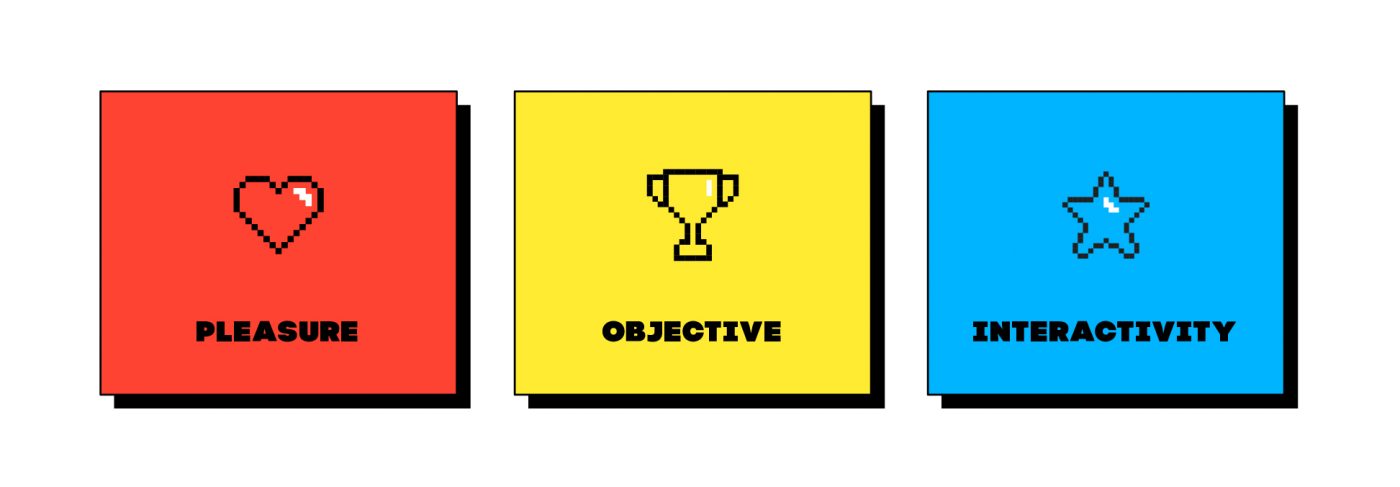
The principles behind gamification have always existed, so why is this phenomenon now gaining ground? For Vicente Martin Mastrocola, assistant teacher at ESPM where he teaches digital platforms, Game Essentials and Game Design, “companies have begun to understand the motivational techniques used by video game designers and apply them in other contexts. These techniques include goal design, badge recognition, team collaboration, stimulation of competition via rankings and points accumulation.”
Just as with the porn industry in the 80s, the game industry in times of pandemic seems to be the driving force for the implementation of emerging technologies such as augmented reality, virtual reality and mixed reality, accelerating their use outside of it. There are plenty of examples: The New Yorker magazine has just released its first animated film in virtual reality; the 2021 edition of the SXSW festival was all online and interactive; Folha de São Paulo newspaper conducted a survey on the impact of the pandemic in an immersive game format; The Black Mirror series produced an interactive episode with multiple endings.
For brands and agencies, we see some opportunities to apply these experiences in processes and methodologies, and in how to interact with the public. For Carina Benitez, designer at CBA B+G, bringing this kind of dynamic to the corporate context makes the contact between all participants more enjoyable. “When we gamify the process, people instinctively want to participate more. This way, something super-ordinary and mundane in their routine ends up gaining a new look.”
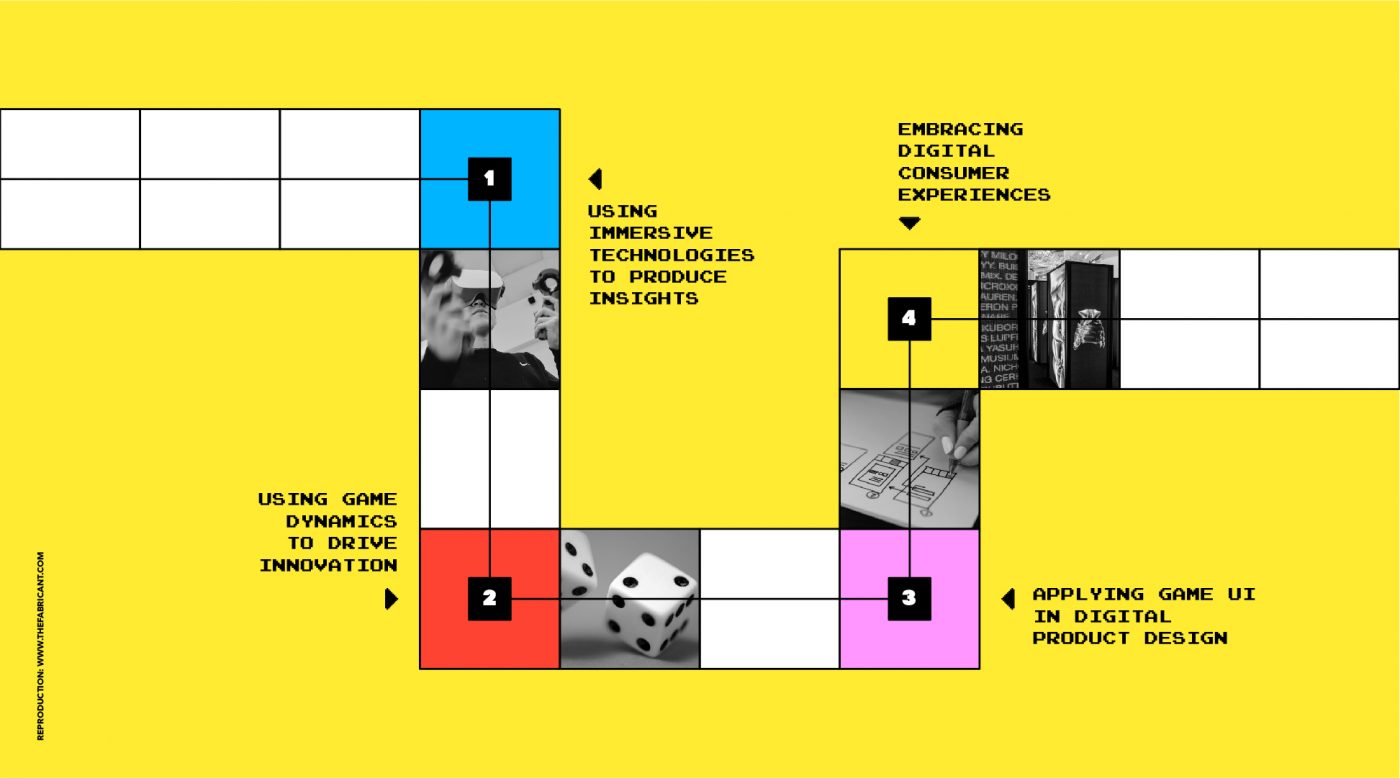
Video games and immersive technology possibilities promise to revolutionize the way we consume and interact with brands. However, it is important to keep in mind that we are also experiencing a technological fatigue: excess screens, confinement and social distancing can lead people to seek a reconnection through physical contact. That’s why we bet that, in the future, brands should invest in gamer culture beyond pure digital, with playful experiences that mix digital and real, such as augmented reality. Our Branding for the future playbook and our article on empathy are good reading tips for those who want to delve into the importance of brands’ online presence and use of hybrid features.
Contact us if you want to chat about the challenges and opportunities for your brand. And if this topic inspires you, and you are or know business professionals, strategists and designers who are interested in being part of our team, write to [email protected] telling us about your expectations, goals and history. We are always in search of talent!
This article had the contribution of: Carmen Beer, Ana Cerqueira, Giuliana Sanchez, Thaísa Miyahara, Ana Paula Moreno, Fabiele Nunes, Carina Benitez, Fabiano Naspolini, Vicente Martin Mastrocola, Josy Lamenza, Daniela Irrazabal, Rosario Maglione, Renato Storni and Luis Bartolomei.

People have never played so much as nowadays. The fast-paced growth of the gaming industry triggered by the need to stay at home during the pandemic is making games win an increasingly diverse and wider audience. The figures are dizzying: in 2019, the market had a turnover of 1.5 billion US dollars in Brazil and 152 billion worldwide, leveraging more investments than cinema and sports. In 2020, electronic games were the most discussed topic on Twitter, with 2 billion tweets. What does this universe represent for brands and how can they play the game?
There is no doubt that games represent today for young people what music used to represent in the 90s: cultural identity and the feeling of belonging to a community. Games are intrinsically linked to young culture, today more than ever. But if your idea of a typical gamer is an antisocial teen geek, think twice. From Candy Crush to Fortnite, the profiles and ways to play are numerous, with games that fit everyone’s time and pocket, matching different lifestyles, personalities and interests.
According to the Pesquisa Game Brasil 2021 survey, 72% of Brazilians say they play electronic games, and most of them have played more online games since the beginning of the pandemic. The casual gamer is best represented by a woman between 25 and 35 years old, while the hardcore is usually a man between 16 and 24 years old. The survey also pointed out that almost half of the players are from the middle, lower and poor social classes. For all of them, the mobile phone is the choice of preference. This explains the success of games like Free Fire, available on mobile and with more than 100 million downloads. On the other hand, consoles are declining, much due to the exorbitant prices charged in Brazil. For Claudio Lima, CEO at Druid Creative Gaming, “the mobile has turned the key to the gaming market in Brazil. Playing was for upper-class individuals, it demanded a console or PC, and that was very expensive. Now, anyone can play. Kids today dream of becoming Free Fire players instead of becoming soccer players.”
In addition to playing, millions also watch other players, professional and non-professional, through streaming platforms that are growing non-stop – Twitch, for example, has more than 15 million daily active users. A global survey in 2020 pointed out that gamers between the ages of 18-25 spend an average of 4 hours a week watching other people online. This phenomenon is creating new types of influencers who play matches with their audience, sometimes hundreds in the same day, creating authentic bonds and a true closeness. The Brazilian gamer Cellbit, for example, has been recording videos for Twitch and YouTube since 2012, counting with more than 6 million followers, with a total of 300 million views.
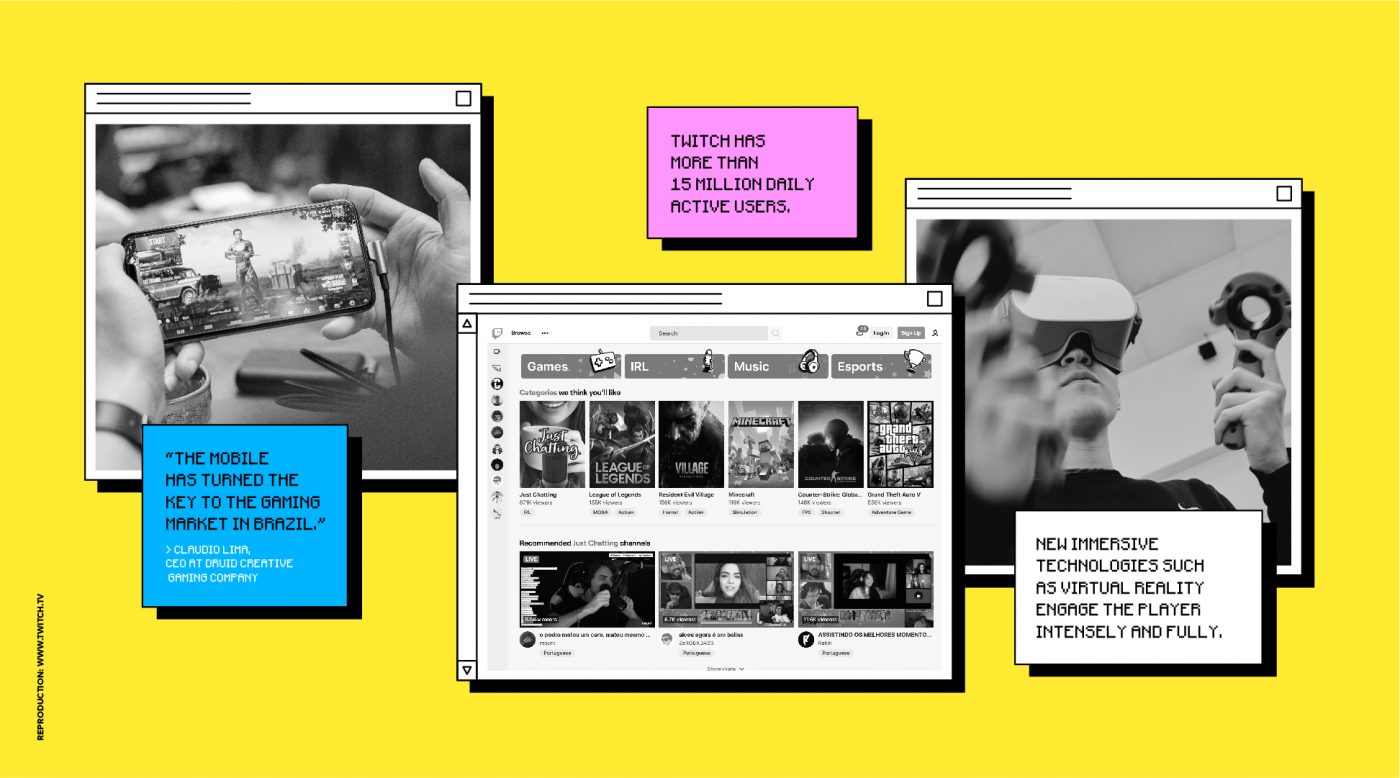
The gaming industry is shaping the future of entertainment, with varied and complex productions, immersive technologies and universes full of possibilities, besides impacting the streaming industry.
Immersive Games like Beyond Two Souls or Cyberpunk benefit from high-budget investments worthy of the biggest Hollywood productions, with the participation of the best writers, actors and artists. The result is the creation of incredible narratives, characters and soundtracks. New immersive technologies such as virtual reality engage the player intensely and fully, while augmented reality blurs the boundaries between real and virtual. And of course, in these universes, players have the possibility to do many other things: their avatars can watch music shows and spend their money in different ways, simulating the real world. Roblox, a very popular platform that allows users to create their own worlds and mini-games, aims to ”unite the world by building a metaverse (a virtual world that digitally replicates the real one), where millions can meet up in games, conferences, or in collaborative jobs within a virtual economy that has its own currency.”
Many non-endemic brands, that is, those that traditionally have no market links with the segment, are entering this world, creating new market dynamics and generating new demands – internally and from their partners. Unilever has created an esports center to better meet the needs of its brands; Publicis Play, launched this year in the UK, brings together a pool of experts from the group to provide creative, media and production support to its customers. In Brazil, Druid started operations at the beginning of the year and seeks to creatively connect games and brands, through a Business to Gamer model.
For traditional brands, entering the gaming world may seem scarier than it really is – but we believe there are far more opportunities than risks. However, entering this game is something that requires preparation, and before you even start creating content and activations, you need to build a solid strategy, consistent with the brand positioning and value proposition, to connect with audiences in an authentic way and not just as another product placer.
We’ve identified some ways in which brands can begin to relate to the gaming world, building bridges with communities to – lightly and unpretentiously – join the conversation:
On the other hand, we believe that some initiatives, at first glance tempting, can in fact be much riskier or less impactful:
As the pandemic subsides, the connections made by players within games will create opportunities outside of them as well. People who have met online will want to meet physically and show how they belong to the communities. Therefore, events will boom and meeting places, such as the famous Lan Gaming Centers, can revive.
Want to continue learning about games, gamer culture and their relationship with brands? We recommend the podcast marketin.gg, which investigates the relationship between games and brands and Netflix’s High Score, a docuseries which tells the story of video games in a fun way. Are you missing the first classic games? Check here how to get access to a number of retro games, for free. Stay tuned and read our article on gamification, or on how brands can apply the mechanics used in games.
Get in touch if you want to chat about the challenges and opportunities for your brand. And if this topic inspires you, and you are or know business professionals, strategists and designers who are interested in joining our team, write to [email protected] telling us about your expectations, goals and history. We are always in search of talent!
This article had the contribution of: Carmen Beer, Ana Cerqueira, Giuliana Sanchez, Thaísa Miyahara, Ana Paula Moreno, Josy Lamenza, Daniela Irrazabal, Rosario Maglione, Renato Storni, Luís Bartolomei, and the special participation of Claudio Lima.
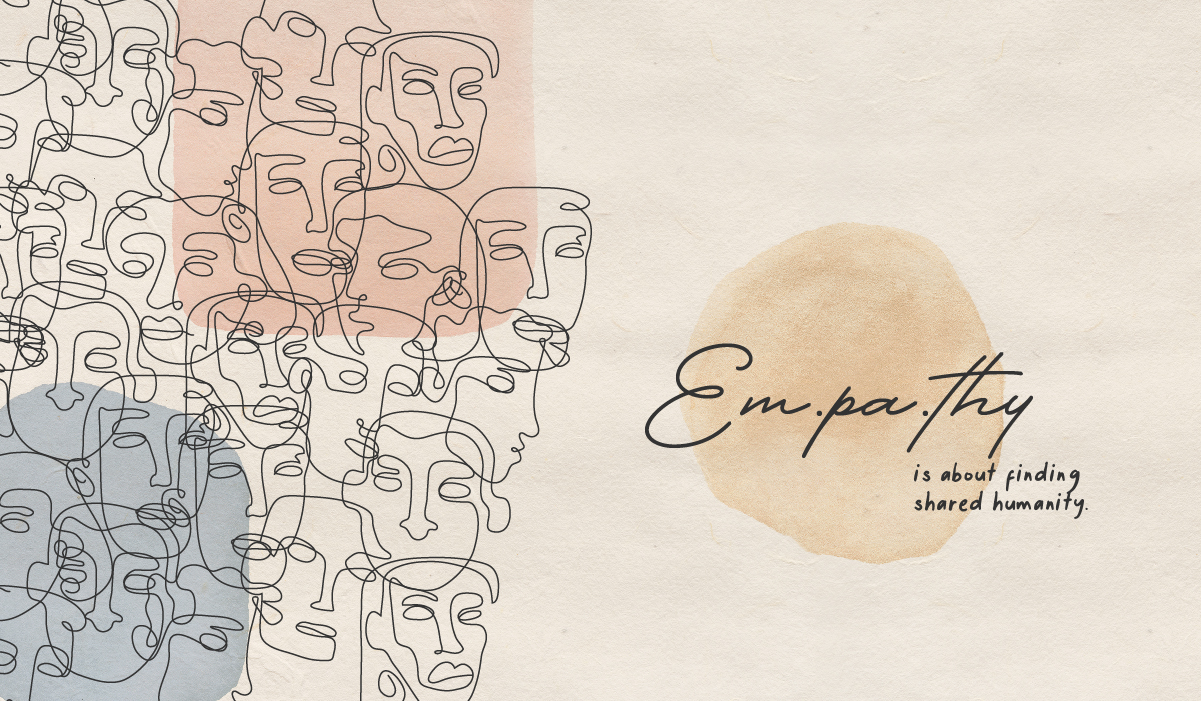
In the day-to-day life of big corporations, agencies or consulting companies it’s easy to forget the target consumer’s reality. Although consumers are on the core of everything that is done, thought and designed, oftentimes stakeholders know them through figures and reports, but rarely see them in flesh. It is a challenging task to make consumer insights known outside the CMI (Consumer & Market Insights) department and engage more of the company’s staff in the process of understanding the target consumer.
Today there is an increasing tendency to value big data and artificial intelligence – which we, at CBA B+G, totally support. However, we can’t forget the great value of building emotional and human ties throughout the research and innovation process, by using tools that promote an empathetic immersion in the lives of consumers.
But what exactly does empathy mean? According to the Australian philosopher Roman Krznaric, it’s about finding shared humanity. He believes that we are urgently in need of empathy to create the ‘social glue’ to hold our society together. From a business point of view, empathizing with consumers is not only ‘cool’; we believe it also leads to transforming, effective and positive results, in three different ways:
Storytelling is at the heart of any empathic process, and there are countless tools, non-digital, hybrid or completely virtual which engage the spectator in the story in a simple, touching and impactful way. Here are some tools and examples that can be applied to society and by brands.
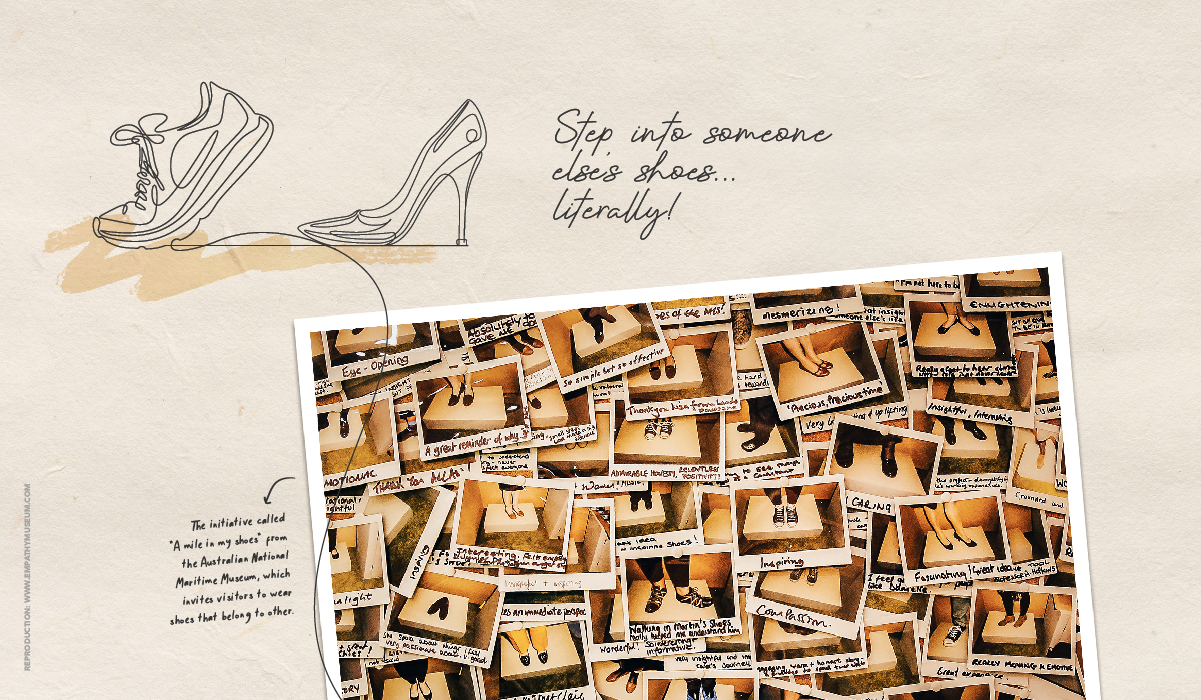
A. Step into someone else’s shoes … literally
If empathy means to step into other people’s shoes, then why not literally do that? That is the proposal of the initiative called “A mile in my shoes” from the Australian National Maritime Museum, which invites visitors to wear shoes that belong to other (real!) people and listen to them telling parts of their stories. In São Paulo, the exhibition “Diálogo com o Tempo” (Dialogue with Time), hosted by Unibes Cultural, has created an immersion environment in the universe of old age, inspired by the same principle.
At CBA B+G, we have applied the same idea during an Innovation workshop held for Plenitude – a brand of disposable underwear, designed for people who suffer from incontinency. We have asked the participants to wear the underwear for three days, to put themselves in the consumers’ shoes and better understand their needs.
“Using the product myself was revealing. We have always focused on absorption, however I noticed opportunities to go beyond. These insights led to new innovative attributes for the product, which are currently being developed by our Engineering team. Today we are close to offering one more benefit to better meet our consumers’ needs”
Mônica Fernandes, CSI Adult Care Leader, Kimberly-Clark
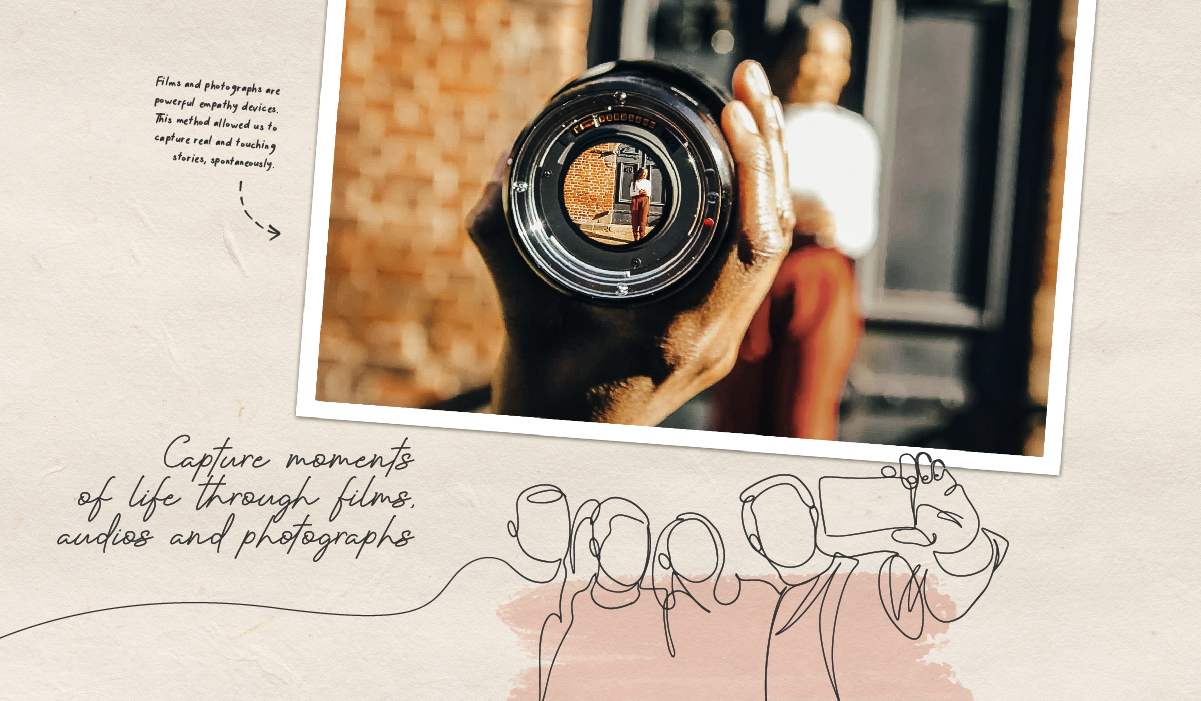
B. Capture moments of life through films, audios and photographs
Films and photographs are powerful empathy devices. This thought led the Chinese artist Ai Wei Wei to create the film “Human Flow” to raise global awareness about the refugees crisis. Brands also make use of empathetic films to create impactful campaigns. “Thank you, Mom”, the most successful campaign in the history of P&G is really touching because it effectively puts spectators in the place of mothers, creating a strong sense of identification.
At CBA B+G, we have been running ethnographic surveys and online diaries about consumers’ journey, asking them to film moments of their lives using their mobile cameras. For one of the partners we work with, from a hitchhiking app, we used the methodology ‘fear accounts’, through which we kept in touch with the app users via WhatsApp during a week, asking them to send us an audio each time they got scared when using the service, telling us what happened and how they felt. This method allowed us to capture real and touching stories, spontaneously.
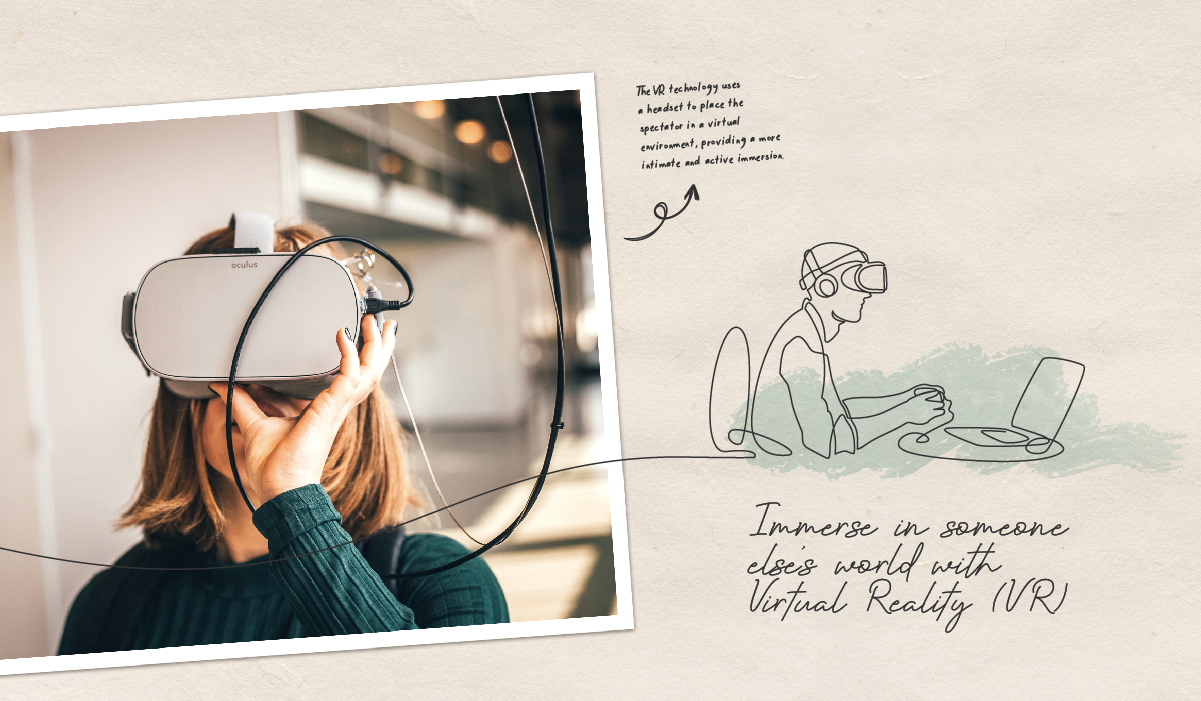
C. Immerse in someone else’s world with Virtual Reality (VR)
The VR technology uses a headset to place the spectator in a virtual environment with a 360 view, providing a more intimate and active immersion. For some people, technology is undoubtedly the best way to step into other people’s shoes. Technology has been used in games, science and arts, to recreate the way autistic people perceive the world, and as an invitation to reflect upon the effects of global warming.
At CBA B+G, we have devised for Nestlé a VR Project – Consumer Connections – to immerse in the lives of the target-consumers of three major brands of the company. One of the project’s expectations was to give everyone in the company – regardless of work department or position – the possibility to get to know the daily lives of people from different realities. The tool made it possible, for example, to follow a typical day in the life of Luiza, a teenager who lives in São Paulo and loves KitKat and skating. To Cibele Rodrigues, Research Manager, at CBA B+G, “the project was enriching and powerfully delightful. It refreshed the target, putting everyone on the same page. Moreover, we escaped the traditional reports, showing more humane journeys. At the end of the day, the figures made more sense, allowing executives to take more assertive decisions, closer to the consumer”.
“The immersion project using VR was one of the most incredible we have ever experienced, which made us think ‘why haven’t we done that before?’ The possibility to follow parts of consumers’ life is the icing on the cake for any insight or marketing professional. The approach was fundamental to make us understand the best moments and ways to connect with them”.
Demer Santos, Consumer & Marketplace Insight Manager, Nestlé
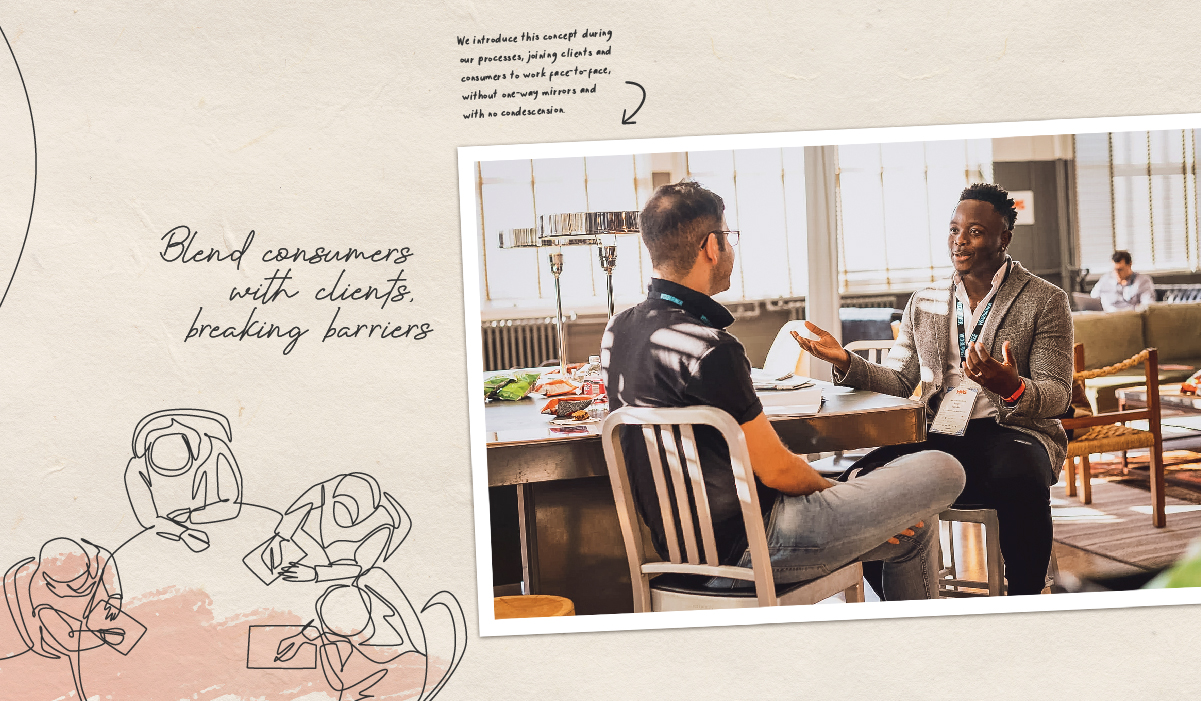
D. Blend consumers with clients, breaking barriers
Who says we cannot mix consumers and clients, spectators and artists, experts and laypeople? Breaking these barriers is also a powerful way to connect people and develop empathy.
We introduce this concept during our processes, joining clients and consumers to work face-to-face, without one-way mirrors and with no condescension. Today, we do the same remotely. Alex Espinosa, CBA B+G’s managing partner and Head of Innovation, explains that the objective is to “create ecosystems where clients, consumers, mentors and experts co-create together with a common purpose, enabling a multi perspective view of the challenge and incorporating experiences that boost the developed solution”.
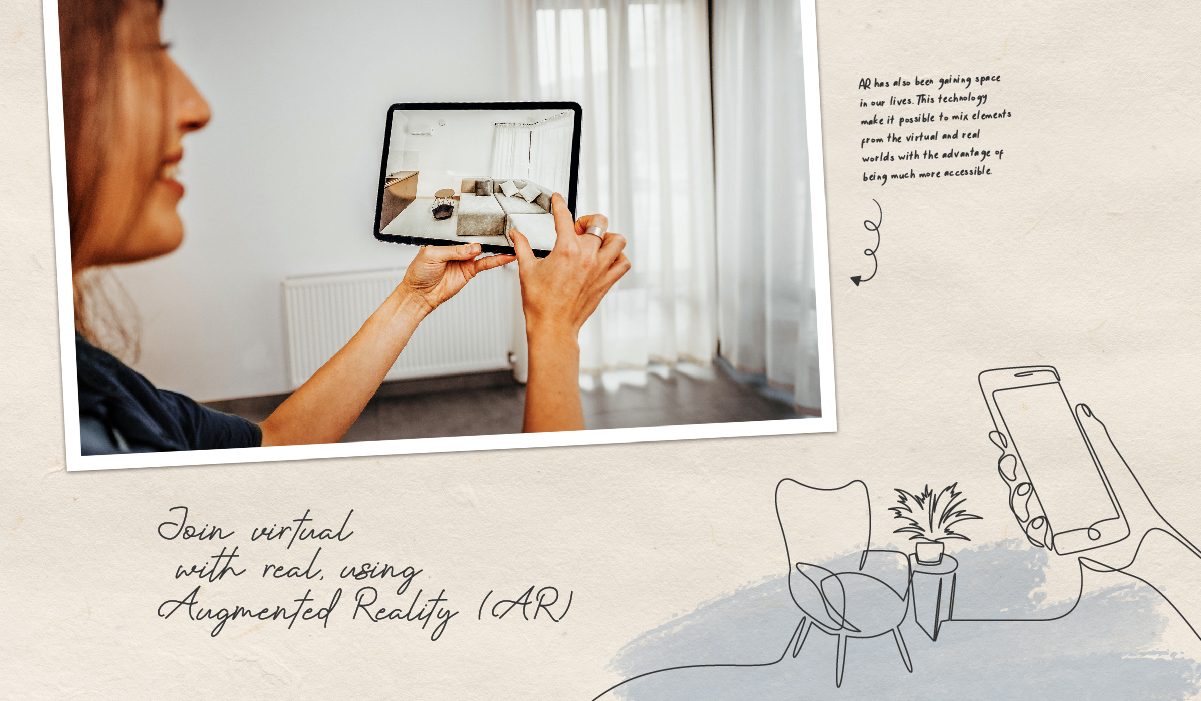
E. Join virtual with real, using Augmented Reality (AR)
AR has also been gaining space in our lives. This technology make it possible to mix elements from the virtual and real worlds with the advantage of being much more accessible, since it doesn’t require a headset and can be easily developed in an app. It has been largely used, both by entertainment games (who remembers the Pokémon Go fever?) as by brands that provide a product trial without the need to leave home. That’s the case of Ikea, that simulates how your sofa would look in your sitting room; or L’Oréal, that offers the possibility to virtually try on different lipstick colors before choosing one.
But how is augmented reality used in research and Innovation? We have recently developed, together with one of our business partners, an app that used AR in a disruptive way, to make a survey about absorbent pads products. Consumers were able to try different shapes and sizes of new products, simulating real use by projecting them in their panties or bikinis. To Alex Espinosa, “technology allows prototypes and products to reach millions of homes without the need of physically producing any of them, in real-time tests that result in products that better fit the target-consumer. It is the fastest and most effective way to validate your MVP (Minimum Viable Product) with consumers and find the added value and possible improvements within minutes”.
We may safely assume that extended reality will continue to evolve and improve to achieve astounding results. We bet on the use of Augmented Reality and other hybrid formats that explore the best of technology to project reality as perceived by others without disregarding human contact. Definitely, digital and analog realities are complementary in capturing insights more sensitively.
To delve into this issue of empathy and its tools more deeply, we recommend watching the TED talk by the Australian philosopher Roman Krznaric about how to start an empathy revolution, as well as the New Yorker’s beautiful immersive animated short-documentary film about detention camps in China. If you don’t have a VR headset or cardboard yet, it’s worth buying one and start playing with these new possibilities.
And of course, don’t hesitate to contact us to understand better how we can help your brand use these tools on your behalf. And if this topic inspires you and if you are or know someone who is a business professional, strategist or designer interested in joining our team, write to [email protected] telling us about your expectations, objectives and history. We are always looking for talent!
This article had the contribution of: Carmen Beer, Ana Cerqueira, Giuliana Sanchez, Thaísa Miyahara, Ana Paula Moreno, Alex Espinosa, Cibele Rodrigues, Demer Santos, Mônica Fernandes, Josy Lamenza, Daniela Irrazabal, Rosario Maglione, Renato Storni and Luis Bartolomei.
Privacy Overview